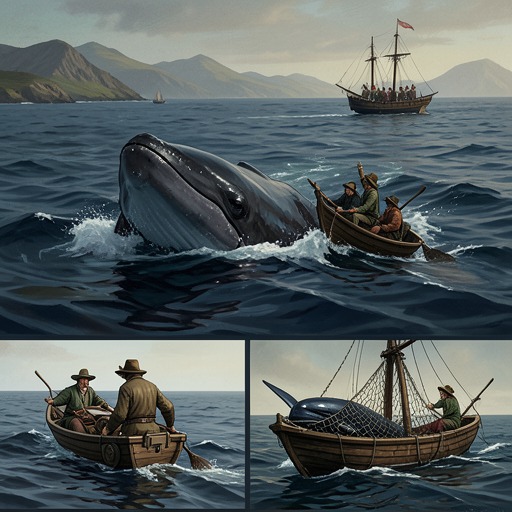
There she blows!
The Whale“There she blows!” is the cry that converts a distant sighting into a whaling ship’s next action. In the account of Herman Melville’s voyage aboard Melville’s Acushnet, it breaks weeks of watchful waiting, summons the crew to the hunt, and later returns after the work of rendering and cleaning is done. The phrase is both practical alarm and recurring refrain: a few words that make the whale visible to the crew, then set the whole laborious cycle in motion.
A cry after the watch
The words arrive at the end of a long interval of anticipation. On Melville’s Acushnet, the men have watched for weeks from the topgallant crosstrees, figures swaying ninety feet above the deck. The cry is not a general celebration but a working signal, spoken when the lookouts finally see what they have been searching for. The distance between watch and sighting gives the phrase its force: until then, the ship and its crew exist in a kind of limbo, while recruits practise in the boats and the crew waits for the hunt to begin.
The account stretches the call into spelled-out syllables: “T-h-e-r-e s-h-e b-l-o-w-s!” The drawn-out lettering makes the cry seem to carry across the space between lookout and deck, and slows the instant of recognition into something the waiting men can hear and answer. The whales then appear “as if mystically summoned from the deep.” That comparison lends the call a spell-like aspect, but the scene immediately returns it to practical consequence. The whale is close under the ship’s lee, less than forty fathoms off, and its broad back is compared to the capsized hull of a frigate. The cry has brought no creature into existence; it has made an animal already there the focus of the crew’s attention.
From sighting to pursuit
As a standalone heading, “THERE SHE BLOWS!” also marks a threshold in the book’s sequence. It precedes the chapter heading “Sealed Orders”; later, the words recur within the account of the voyage itself. The page-level declaration anticipates the shouted call at sea, while the scene gives the expression its circumstances: men aloft, a whale near the ship, and a crew for whom spotting means that waiting is over. The phrase thus connects a chapter’s dramatic announcement to the workaday procedure of a whaling voyage.
The men’s cry begins a change from looking to pursuit. After the sighting, the narration presents a Sperm whale rolling close to the vessel, its glossy back catching the sun. At other times, the crew sees twenty or thirty whales riding and tumbling in the waves. The observation of their movement does not remain detached for long: even when the animals are at play, the order comes to lower the boats. The expression stands at the hinge between the crew’s visual encounter with whales and the human decision to pursue them. Its urgency belongs to the ship’s organization as much as to the wonder of seeing an animal emerge from the sea.
A refrain in the work cycle
The call returns after a whale has been caught and processed. The ship is scrubbed, and unrefined sperm oil is described as having a cleaning virtue; after an “affair of oil,” the decks look especially white. The men, too, have cleaned themselves and are buttoning the necks of their clean frocks. The detail makes the next cry a sharp reversal: just as ship and crew appear restored, the lookouts shout again, “There she blows!” The men “fly away to fight another whale, and go through the whole weary thing again.”
In this recurrence, the words no longer signal only the beginning of an exciting pursuit. They announce the restart of work whose stages have just been completed: capture, processing, cleaning, and another departure. The clean deck is not a lasting end to the labor but a brief pause before its repetition. Set beside the crew’s weary return to action, the cry sounds at once efficient and relentless. Its compactness is part of that effect: the same short call can initiate another whole sequence of physical effort.
Significance of the expression
The book gives the phrase several linked functions without separating them. It is a lookout’s report, a cue that reorganizes the crew’s attention, and a refrain that links separate encounters across the voyage. It also carries an unresolved tension between spectacle and extraction. The whale’s immense body, its movement among the waves, and the crew’s admiration for its speed are presented as striking sights; yet the order to lower the boats turns looking into pursuit. The call makes that turn audible.
Its recurrence also prevents the hunt from seeming like a single exceptional adventure. The crew hears the same words after a fresh watch and again after the ship has been scrubbed, and each hearing begins another round. That repetition gives the expression a larger significance than simple identification: it is the verbal mechanism by which the ship’s attention becomes action and by which the labor of whaling renews itself. The phrase promises discovery, but in the account its consequence is a return to the same weary business.